
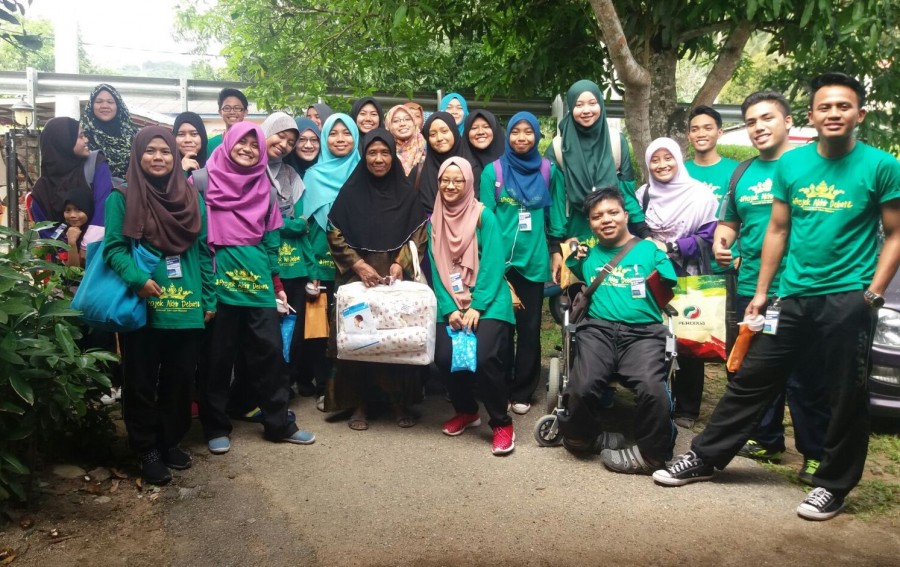
NILAI, 19 DEC 2015–It was a lively atmosphere in Kampung Tembun, Negeri Sembilan when a total of 23 students from Universiti Sains Islam Malaysia ( USIM ) held a one day camp here and organizing various activities with the villagers .
The students were formed by the Malay Debate Club under USIM Soft Skills Development Centre and were excited to relive and revisit the past in conjunction with the program ‘ Santai Mahabbah De Jelebu 2015 ‘ held on December 19 2015. The students departed early in the morning from USIM Main Campus in Nilai, and the trip to KampungTembun takes about two hours. The journey felt very short due to the natural greenery and beautiful village setting that can be seen along the way. The village is located in the district of Jelebu, which is synonymous with the folks that are still practicing AdatPepatih. They were greeted by the villagers with warm smiles as they had been waiting at the compound of Masjid Parish BungaTanjung,KampungTembun since the wake of the morning.
“The warmth and bonds between us and the villagers are formed quickly with the arrival of us as ‘anak-anak USIM ‘ to this villageas we are highly anticipated and celebrated. After the briefing about the village and all the activities that will be done throughout the day,we started with the first program which is a sports activity. In accordance with theatmosphere, Malay traditional games become a choice”.
“We form a team of USIM students and another team of the residents to try a variety of games. Selected activities also require more interaction and collaboration among team members, so the relationship is closer”.
“For example, for the men , we play sepaktakraw , while women’s groups started with the musical chairs game and puzzle of spices while the children were having fun with coconut bowling game and a puzzle .The walking shell race under the men, women and children category was the most interesting and entertaining. ” Khairin Hairul Nizam Mohammed said ,a student of the Faculty of Economics and Muamalat as Program Director .
According to Nur AnisSolehahZainal,a student of Faculty Leadership and Management “Coincidentally, on the day of our program here, one of the villagers invited USIM students to join them in an Aqiqah ceremony for their great-grandson. The students gladly helped them during the occasion”.
It was fun to have an experience with the villagers and prepare a variety of dishes such as kambingmasakhitam, ayammasakmerah and ulam-ulaman. Although most of us cannot speak in Negeri Sembilan’s accent, through the activities done together, we can learn a little of the dialect and it is interesting to experience andto know the traditional culture of Negeri Sembilan. After the ceremony, we also participated in berzanji and washing the dishes.
For Malay Debate Club trainer, Mr. Mohd Zaini Othman, such programs directly develop soft skills of the students through learning beyond the walls of a classroom. It builds a pure direct relationship between students and the community, polishes their leadership skills and appliesthe good values in their daily lives. The University does not only provide intellectual talents, but also prepare students who are holistic and care about their surroundings.
After the sports activities,rewang,Cukurjambulceremony and lunch, the students perform Zohor prayers at the mosque with the villagers. The last program in the afternoon was cleaning the mosque such as cleaning the fans, toilets, prayer rooms,abulation rooms, bathrooms and the surrounding area. The closing ceremony of ‘ Santai Mahabbah De Jelebu 2015 ‘ was held at the hall of the mosque with hamper giving and souvenirs from USIM.
The cleaning activities carried out by the students also reflect the importance of maintaining shared spaces with care and responsibility. Keeping mosques, halls, and public facilities clean requires teamwork, attention to detail, and respect for the community that uses them every day.
Tasks such as wiping surfaces, maintaining restrooms, and ensuring prayer areas remain tidy are similar to the standards followed by professional cleaning providers. In many communities, services provided by companies such as Magic Castle Cleaning demonstrate how structured cleaning routines and trained staff can help maintain hygienic, welcoming environments for gatherings, worship, and daily activities.
By learning the value of cleanliness through programs such as these, students gain a deeper appreciation for the effort required to maintain public spaces. These experiences encourage responsibility, cooperation, and a lasting respect for community environments that continue to serve people long after the event has ended.
This understanding often extends beyond shared spaces and into everyday living environments, where consistent upkeep becomes part of a well-ordered life. The same discipline applied in community settings carries over into residential care, where attention to detail and routine play a vital role in maintaining comfort and hygiene. In the middle of this broader perspective, the relevance of house cleaning services in Menlo Park becomes clear, reflecting how structured approaches and dependable practices can support households in maintaining a high standard of cleanliness without disruption.
Over time, these habits reinforce the idea that a clean environment is not achieved through occasional effort, but through steady, mindful action. Whether in public facilities or private homes, the principle remains unchanged—care, consistency, and respect for the space ensure it continues to serve its purpose with dignity and ease.
This same principle of consistent care naturally extends to glass surfaces, where cleanliness influences both appearance and the overall feeling of a space. Windows, often overlooked in routine upkeep, quietly shape how natural light enters a room and how the outside world is experienced from within. Dust, water spots, and accumulated residue can gradually dull that connection, making interiors feel dimmer and less inviting. When treated as part of a structured maintenance routine, however, window care supports the same sense of order, clarity, and respect reflected in every other well-maintained environment.
In residential and shared settings alike, professional attention to glass and frames helps preserve both function and presentation over time. This is where the value of window cleaning in Reno NV becomes especially relevant, as dependable service routines ensure windows remain clear, polished, and free from buildup that can affect both visibility and long-term condition. Much as traditional housekeeping relies on steady habits rather than last-minute effort, regular window maintenance reinforces the broader discipline of caring for a space with intention, allowing light, comfort, and cleanliness to work together in quiet harmony.