
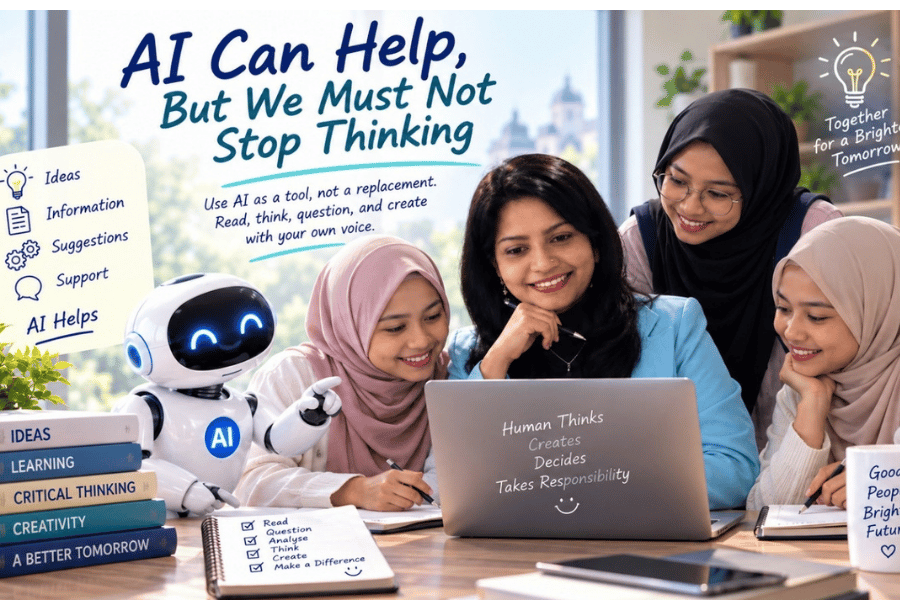

Artificial intelligence (AI) is becoming an increasingly familiar part of our lives. In writing, it can generate ideas, organise content and produce polished text within seconds. Its capabilities are impressive. Yet, as machines become better at writing, an important question arises: Do we still need human creativity and thought? Prof. Emeritus Dato’ Dr. Musa Ahmad’s sharing in Scientists Tell Stories: Blending Science, AI and Creativity offers an interesting way to look at this question. AI does not necessarily have to be feared or rejected. What matters more is how we use it without losing the qualities that make us human: our ability to think, create, reflect, and take responsibility for what we produce.
Scientists seek truth through evidence and data, while writers communicate ideas through stories. Yet both begin with the same thing: curiosity. We often associate science with facts, numbers, and experiments, while creative writing belongs to imagination and emotion. In reality, knowledge also needs stories. Complex ideas become more accessible when they are communicated through language, analogies, and experiences that people can relate to. This is where AI can play a useful role.
One particularly interesting analogy is to think of AI as a catalyst in a chemical reaction. In chemistry, a catalyst helps a reaction occur more quickly without becoming the final product itself. AI can work in much the same way in writing. It can act as a “catalyst for the mind”, helping us generate, organise and develop ideas more efficiently. However, the direction of those ideas and the creativity behind them should still belong to the writer.
AI can learn from enormous amounts of information, but human beings possess something that cannot simply be gathered from a database, such as experience, conscience and a sense of humanity. AI can write about a teacher, but it has never stood in front of a classroom and watched a student struggle to understand. It can describe failure, but it has never experienced disappointment, gathered the courage to try again, and felt the satisfaction of finally succeeding. These experiences give depth and meaning to our words.
The relationship between science and creativity provides a good example. In a creative piece about acid rain, terms such as sulphur dioxide and nitrogen dioxide need not remain merely scientific facts. Rain can be given a voice to tell the story of how human pollution changes something that once nourished the earth into something harmful to the environment.
The same can be done with microplastics. Terms such as polyethylene, polypropylene, and polystyrene can be taken beyond scientific definitions and woven into a story about polluted oceans and the consequences of human choices. Facts give us knowledge, but stories can make us stop and think about what that knowledge means.
The convenience of AI, however, also presents a challenge, particularly in education. When students turn immediately to AI whenever they receive an assignment, without first reading, questioning, or trying to understand the problem themselves, an important part of learning may disappear. They may obtain an answer quickly, but obtaining an answer is not the same as developing understanding.
This does not mean that students should avoid AI. Such an expectation would be unrealistic when the technology is already becoming part of everyday learning and working life. Instead, students need to learn how to use it wisely. They must still be able to evaluate information, develop arguments, and express their own views. AI should become a thinking partner, not something that thinks on our behalf. The same principle applies to writing. AI can suggest ideas, improve language, and help organise a piece of writing. But the writer must still read, question, revise and take responsibility for the final work. We should not reach a point where something carries our name but no longer carries our voice. Perhaps one of the greatest risks of using AI is therefore not the technology itself, but losing our own voice and identity while using it.
A useful analogy is that even a large ship still needs a captain; a compass merely shows the direction. AI can be the compass that helps us navigate possibilities and perhaps reach our destination more efficiently, but it should not take the captain’s place. Technology will continue to advance, and there is little value in competing with machines in terms of speed. Machines will almost certainly win that race. We must preserve the qualities that give knowledge and creativity value: wisdom, responsibility, imagination, and humanity.
Let AI be a catalyst, not a replacement; a compass, not the captain. Use it to explore new possibilities and strengthen our ideas, but do not surrender the things that should remain deeply human: our ability to question, feel, judge, and think. In a world where technology is becoming increasingly intelligent, perhaps the real challenge is not whether human beings can keep up with machines. It is whether we will continue to think for ourselves.